

Self-Hosted PostgreSQL vs Supabase: Architecture & Cost
Comparing vanilla managed Postgres with Supabase's full-stack BaaS ecosystem (Auth, Storage, Realtime, pgvector).
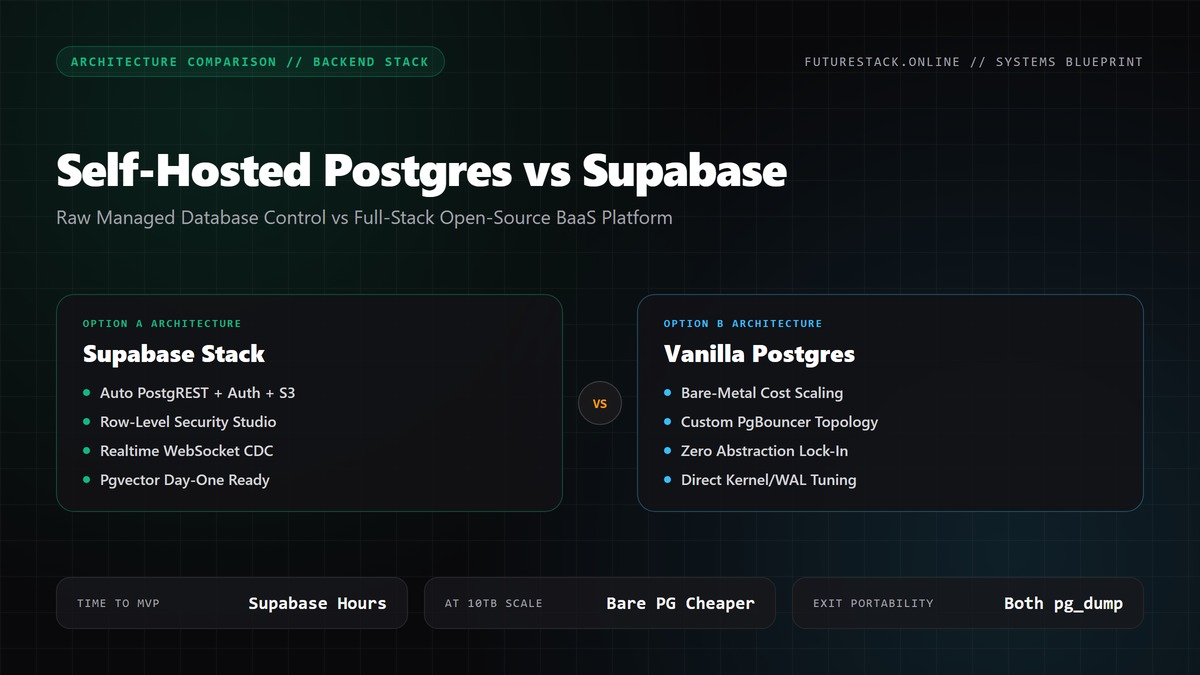
Every Supabase project is a genuine PostgreSQL database at its core. The question is whether your team benefits from having Auth, Realtime, Storage, and an intuitive dashboard bundled around Postgres, or if you prefer a lean, standalone database server without any opinionated abstractions.
Supabase
The open source Firebase alternative built on PostgreSQL
Vanilla PostgreSQL (RDS / Neon)
The world's most battle-tested open-source relational database
Technical Benchmark Criteria
| Evaluation Metric | Supabase | Vanilla PostgreSQL (RDS / Neon) | Advantage |
|---|---|---|---|
Time to First Production Feature Supabase provides pre-built Next.js auth helpers and storage SDKs out of the box. | < 1 hour (Auth + DB + Storage included) | Days (Requires assembling multiple tools) | Supabase |
Data Portability Because Supabase is standard Postgres, you can export your database via pg_dump at any time without proprietary lock-in. | Standard Postgres dump (pg_dump) | Standard Postgres dump (pg_dump) | Tie |
For modern Next.js applications and AI startups, Supabase saves hundreds of hours of backend plumbing. For massive enterprise monoliths with existing auth systems, bare managed PostgreSQL offers lower long-term infrastructure costs.
Frequently Asked Questions
Can I self-host Supabase on my own server?
Yes, Supabase is 100% open source and provides Docker Compose and Kubernetes Helm charts for self-hosting on any cloud or VPS.